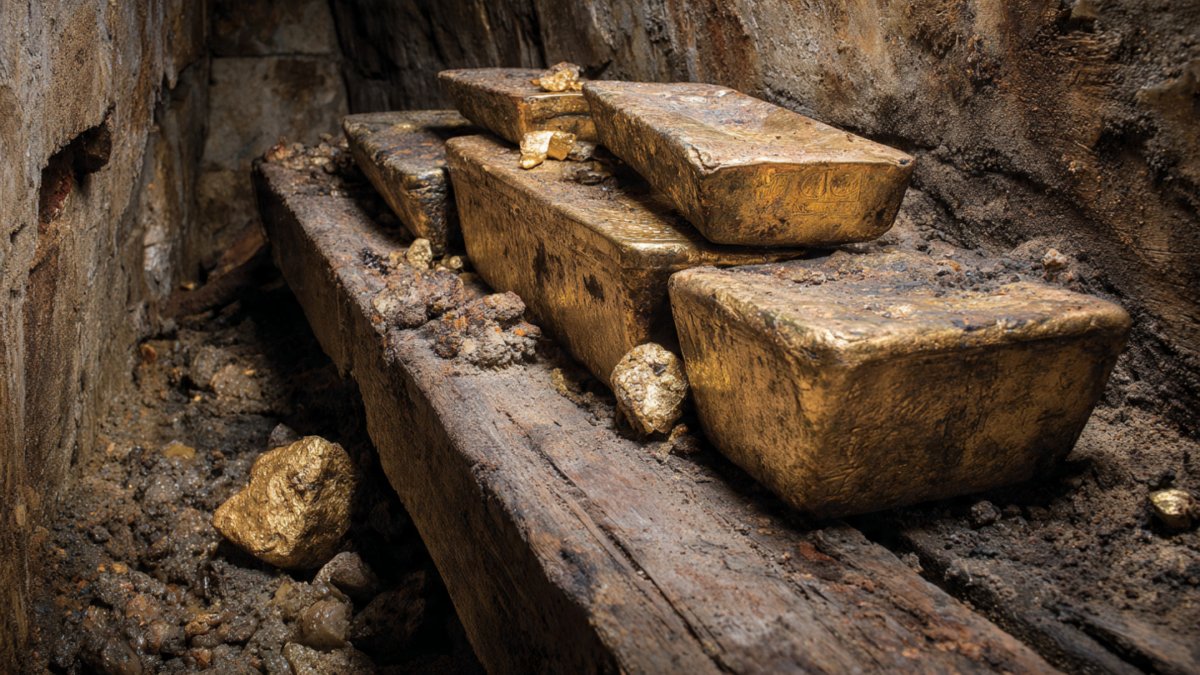
In what experts are calling one of the most extraordinary mineral discoveries of modern times, a massive cache of gold bars has been unearthed more than a kilometre beneath the Earth’s surface, deep within an ancient geological formation. The discovery, made during a routine deep-mining and geological survey project, has stunned scientists, economists, and historians alike. Not only is the quantity of gold remarkable, but its origin has been traced back to a single nation—revealing a surprising story of ambition, secrecy, and forgotten history.
This unprecedented find is already being described as the “find of the century,” not just for its monetary value, but for the mysteries and global implications it carries.
A Discovery Hidden in the Depths
The discovery occurred during an advanced drilling operation designed to study seismic stability and mineral composition in a remote region known for its ancient rock formations. Engineers were using ultra-deep drilling technology to collect rock samples from more than 1,000 meters below ground when their instruments detected unusually high metallic readings.
At first, researchers assumed they had encountered a rich vein of natural gold ore. However, when robotic cameras and specialized excavation equipment were deployed, they revealed something far more astonishing: neatly stacked, refined gold bars embedded within a sealed cavern.
Unlike naturally occurring gold deposits, these bars were clearly man-made. Each had precise edges, uniform weight, and official markings that suggested industrial-level refinement. The discovery immediately raised questions. How could such a large quantity of processed gold end up buried so deeply underground?
The Scale of the Treasure
Initial surveys estimate that the underground chamber contains more than 40,000 gold bars, each weighing approximately 12.5 kilograms, the standard used in international bullion markets. This puts the total weight at over 500 metric tons.
At current market prices, the value of the gold is estimated to exceed several tens of billions of dollars, instantly placing it among the largest known gold reserves ever discovered in a single location.

What makes this find even more remarkable is that the bars were not scattered randomly. They were arranged in reinforced stone compartments, suggesting deliberate storage and long-term planning. Carbon dating of surrounding materials indicates the chamber may have been sealed more than 70 years ago.
Tracing the Origin
Once the bars were carefully extracted and analyzed, forensic metallurgists began examining their composition and markings. Each bar carried serial numbers, refinery stamps, and purity indicators. These details became the key to solving the mystery.
Using international bullion records, researchers were able to match the markings to a major national refinery that operated during the mid-20th century. Chemical analysis of trace elements within the gold further confirmed its geographic origin.
All evidence pointed to a single country: a major economic power that played a central role in global politics during and after World War II.
While officials have avoided naming the country prematurely, leaked reports and independent investigations strongly suggest that the gold originated from state-controlled reserves accumulated during a period of intense geopolitical tension.
A Forgotten Chapter of History
Historians now believe the underground chamber may be linked to a secretive government project launched during the early Cold War era. At the time, fears of nuclear conflict, foreign invasion, and economic collapse were widespread. Many nations sought unconventional ways to protect their financial assets.
According to newly uncovered documents and archival records, this particular nation developed contingency plans to hide portions of its gold reserves in ultra-secure locations, including deep underground vaults carved into bedrock.

The goal was simple: ensure that even in the event of war, occupation, or political upheaval, the nation’s wealth would survive.
Over time, political changes, administrative restructuring, and classified operations may have caused these hidden vaults to be forgotten. Some historians believe that key records were destroyed or lost, leaving the underground reserve buried both physically and in memory.
How Was It Preserved?
One of the most fascinating aspects of the discovery is the exceptional condition of the gold. Despite spending decades underground, the bars show minimal corrosion or degradation.
Geologists explain that the chamber was located within a highly stable rock formation with extremely low moisture levels. Additionally, engineers who designed the vault used advanced sealing techniques, including mineral-based insulation and airtight stone barriers.
These measures prevented water infiltration, microbial activity, and chemical reactions that could have damaged the metal. In effect, the chamber functioned as a natural time capsule, preserving its contents almost perfectly.
Economic Implications
The sudden revelation of such a massive gold reserve has sent ripples through global financial markets. Gold prices briefly fluctuated as investors speculated on the potential impact of releasing hundreds of tons of bullion into circulation.
Economists caution that if the gold were sold rapidly, it could depress prices and destabilize commodity markets. For this reason, experts expect any redistribution to happen slowly and under strict international supervision.

Central banks and financial institutions are now closely monitoring developments. Some analysts believe the discovery could influence monetary policy, reserve management, and currency stability for years to come.
Legal and Political Challenges
Determining ownership of the gold has proven to be highly complex. International law regarding buried assets, historical claims, and state property is often ambiguous, especially when decades have passed.
The nation identified as the source has already issued preliminary statements asserting legal ownership. However, the country where the gold was found may also claim rights based on territorial jurisdiction.
In addition, international organizations are urging transparency, emphasizing that such a valuable resource should be handled responsibly and ethically.
Diplomatic negotiations are expected to take months, if not years, as governments, legal experts, and historians attempt to resolve competing claims.
Public Reaction and Media Frenzy
News of the discovery spread rapidly, dominating headlines and social media platforms worldwide. Many have compared it to legendary treasure finds of the past, such as sunken ships, lost temples, and ancient hoards.
However, unlike mythical treasures, this discovery is firmly rooted in modern history and geopolitics, making it even more compelling.

Documentary filmmakers, journalists, and researchers have flocked to the site, eager to uncover more details. Museums are already planning exhibitions that will showcase selected bars and explain their historical significance.
For the public, the story offers a rare glimpse into the hidden mechanisms of power, wealth, and security that shape global affairs.
Technological Breakthroughs Behind the Find
The discovery would not have been possible without recent advances in deep-earth exploration technology. High-resolution ground-penetrating radar, AI-driven mineral analysis, and autonomous drilling systems played crucial roles.
These tools allowed scientists to identify anomalies far below the surface and investigate them with minimal environmental disruption. Experts believe similar technologies could lead to more hidden discoveries in the future, potentially reshaping our understanding of underground resources.
As exploration methods continue to improve, more forgotten structures, vaults, and deposits may come to light.
What Happens Next?
For now, the gold remains under tight security at a temporary storage facility. Multinational teams are continuing to study the site, mapping surrounding tunnels and searching for additional chambers.
There is also ongoing research into whether similar vaults may exist elsewhere. Some historians speculate that this chamber was part of a wider network of underground reserves.

If confirmed, the current discovery could represent only a fraction of a much larger hidden system.
A Discovery That Redefines Modern Treasure
The unearthing of thousands of gold bars more than a kilometre underground has transformed a routine geological survey into a historic event. It has connected modern technology with forgotten political strategies, revealing how deeply nations once went—literally and figuratively—to protect their wealth.
More than just a financial windfall, this discovery is a reminder that the Earth still holds secrets shaped by human ambition, fear, and foresight. It challenges assumptions about transparency, record-keeping, and the permanence of institutions.
As investigations continue and diplomatic negotiations unfold, one thing is certain: this remarkable find will be studied and debated for generations. It stands as proof that even in an age of satellites and digital records, some of humanity’s greatest stories remain hidden beneath our feet, waiting patiently to be discovered.

Leave A Comment