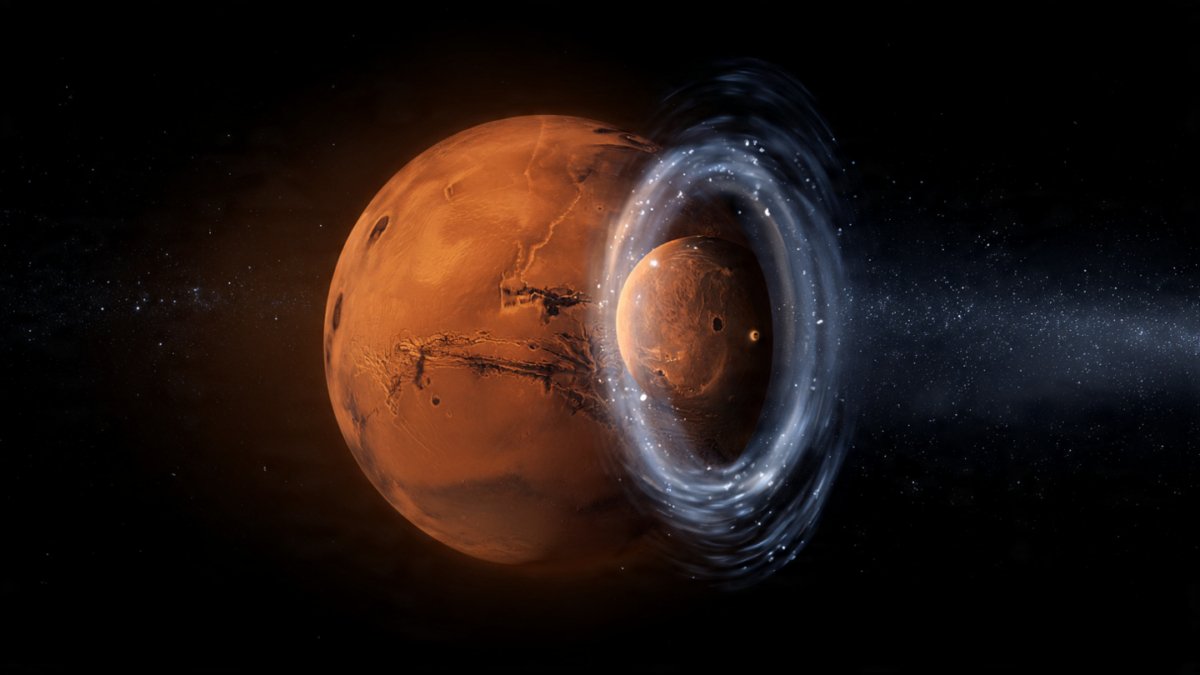
More than a century ago, Albert Einstein revolutionized our understanding of the universe with his theory of relativity. His groundbreaking ideas revealed that time is not fixed or universal. Instead, it moves at different speeds depending on gravity and motion. What once sounded like abstract physics has now been confirmed beyond Earth. Mars, our neighboring planet, has provided real evidence that time truly flows differently there, just as Einstein predicted. This discovery is reshaping how scientists plan future space missions and prepare for long-term human exploration of the Red Planet.
Einstein’s Vision of Flexible Time
Before Einstein, scientists believed time was absolute. One second on Earth was thought to be the same everywhere in the universe. In 1905 and 1915, Einstein challenged this idea with his special and general theories of relativity. He showed that time slows down when objects move at high speeds and when they are near massive objects that create strong gravitational fields.
According to general relativity, gravity bends space and time. The stronger the gravity, the slower time passes. On Earth, this effect is small but measurable. On larger bodies like the Sun or smaller ones like Mars, the flow of time changes slightly. These differences may seem tiny, but in space exploration, even microseconds matter.
Why Time Moves Differently on Mars
Mars is smaller than Earth, with about 38 percent of Earth’s gravity. Because its gravitational pull is weaker, time passes slightly faster on Mars than on our planet. This effect comes directly from Einstein’s equations. Lower gravity means less warping of spacetime, allowing clocks to tick a little quicker.
In addition, Mars moves differently through space compared to Earth. Its orbit, speed, and position in the solar system also affect how time is experienced. When combined, these factors create a measurable time difference between Earth and Mars.
Scientists have confirmed this using extremely precise atomic clocks placed on spacecraft orbiting Mars and on Earth-based systems that communicate with them. By comparing signals sent back and forth, researchers can detect tiny delays that match Einstein’s predictions.

How Scientists Measured Martian Time
Modern space missions rely on atomic clocks that measure time with extraordinary accuracy. These clocks can detect differences of billionths of a second. When spacecraft such as orbiters, landers, and rovers operate around Mars, their onboard clocks remain synchronized with Earth systems.
Over time, scientists noticed small discrepancies. Signals arriving from Mars were slightly ahead of schedule compared to what classical physics predicted. After accounting for distance and signal delay, the remaining difference matched relativistic time dilation.
Advanced models now include both gravitational and motion-based time effects. These models have been tested repeatedly through Mars missions, confirming that time on the Red Planet flows just a bit faster than on Earth.
Why Tiny Time Differences Matter
At first glance, a difference of microseconds per day may seem meaningless. In daily life, humans cannot notice it. However, space exploration depends on perfect timing. Navigation, communication, and scientific experiments all rely on synchronized clocks.
Even a small timing error can cause serious problems. Spacecraft navigation systems calculate position based on how long signals take to travel. If time measurements are off, the spacecraft may drift from its intended path. Over millions of kilometers, tiny errors can grow into major deviations.
For robotic missions, incorrect timing can lead to missed commands, failed landings, or lost data. For human missions, the risks are even greater, involving life-support systems, emergency responses, and return trajectories.

Impact on Mars Navigation Systems
Just as GPS on Earth relies on relativistic corrections, future Mars navigation systems must also account for time differences. On Earth, GPS satellites experience both weaker gravity and higher speeds, causing their clocks to tick faster than ground clocks. Engineers correct this daily.
A similar system is being planned for Mars. Scientists are developing a “Mars GPS” network of satellites that will help rovers, drones, and astronauts navigate the planet. These satellites must be programmed with precise relativistic adjustments.
Without these corrections, location data could drift by meters or even kilometers over time. For autonomous vehicles exploring Mars, such errors could mean falling into craters, missing scientific targets, or becoming stranded.
Communication Challenges Between Earth and Mars
Communication between Earth and Mars already faces delays of 4 to 24 minutes, depending on their positions. Time dilation adds another layer of complexity. Every message exchanged must be synchronized to prevent data loss.
Future missions will rely heavily on automated systems that operate independently for long periods. These systems need accurate internal clocks that stay aligned with Earth-based networks. Engineers now incorporate relativistic models directly into spacecraft software.
This ensures that scientific data, navigation updates, and emergency signals remain reliable even over vast distances.

Preparing for Human Missions
As space agencies plan crewed missions to Mars, time differences become even more important. Astronauts will live and work on Mars for months or years. Their daily routines, experiments, and medical monitoring systems will depend on synchronized timekeeping.
Life-support systems require precise timing to regulate oxygen, temperature, and water recycling. Medical devices track heart rates, sleep cycles, and medication schedules. All of these systems rely on accurate clocks.
In addition, mission planners on Earth must coordinate with astronauts on Mars. Even slight timing mismatches could disrupt operations, especially during emergencies.
By understanding how time behaves on Mars, scientists can design systems that automatically adjust and remain stable throughout long missions.
Psychological and Biological Effects
Although the physical time difference is tiny, Mars has a different day length, known as a “sol,” which lasts about 24 hours and 39 minutes. Combined with relativistic effects, this creates a unique time environment.
Astronauts will need to adapt to this new rhythm. Sleep patterns, work schedules, and mental health programs must be carefully planned. Accurate timekeeping helps regulate circadian rhythms and reduce stress.

Researchers are studying how long-term exposure to altered time cycles affects the human body. These studies are essential for ensuring astronaut well-being during extended missions.
Benefits for Science and Technology
Confirming Einstein’s predictions on Mars is not just useful for space travel. It also advances fundamental physics. Every successful test of relativity strengthens our understanding of the universe.
These measurements help scientists refine models of gravity, spacetime, and planetary motion. They may even contribute to future discoveries about dark matter, black holes, and cosmic expansion.
Technologically, the need for ultra-precise timekeeping drives innovation. Better atomic clocks, improved sensors, and smarter software developed for Mars missions often find applications on Earth. They enhance telecommunications, navigation, and scientific research worldwide.
Looking Toward the Future
As humanity prepares to become a multi-planet species, understanding time beyond Earth is essential. Mars is only the beginning. Future missions to Jupiter’s moons, Saturn, and beyond will face even stronger relativistic effects.
Each new destination will require customized time models. Engineers will design clocks and navigation systems that adapt automatically to local gravitational conditions. Artificial intelligence may play a major role in managing these complex adjustments.

In the long term, interplanetary travel could lead to entirely new ways of measuring time, tailored to different regions of space.
Einstein’s Legacy Among the Stars
Albert Einstein never traveled to space, yet his ideas now guide every major mission. His prediction that time is flexible has been confirmed on Earth, in satellites, near black holes, and now on Mars.
What once seemed like theoretical mathematics has become a practical tool for exploration. Every rover that moves, every signal that travels, and every future astronaut who walks on Mars depends on Einstein’s insights.
Conclusion
The discovery that time flows differently on Mars is a powerful reminder that the universe operates under subtle but profound laws. Einstein’s theory of relativity, developed over a century ago, has proven accurate once again.
By confirming these effects on the Red Planet, scientists have taken a crucial step toward safe and successful interplanetary travel. These tiny differences in time may be invisible to humans, but they shape the future of space exploration.

Leave A Comment