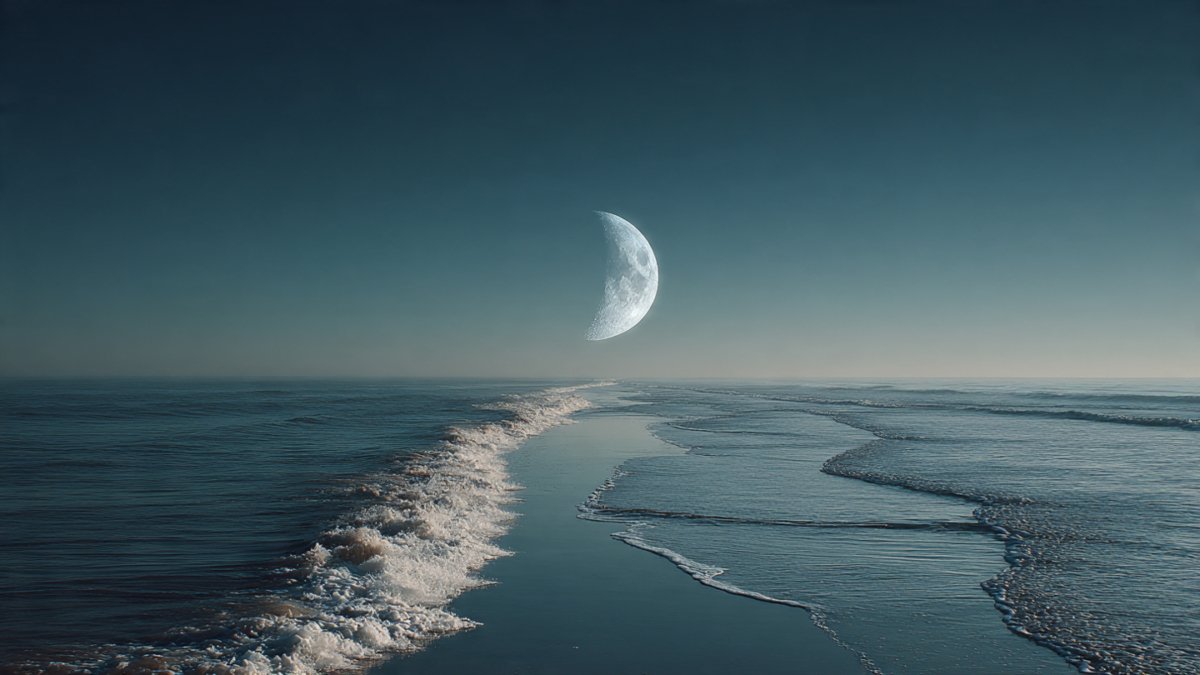
Since ancient times, humans have looked up at the Moon in wonder, noting its phases, tides, and its seemingly constant presence in the night sky. Yet the Moon is not as fixed as it appears. Over billions of years, it has been slowly drifting away from the Earth—a phenomenon with subtle but profound effects on our planet. Scientists now know that this gradual drift is altering the length of our days, the intensity of tides, and even the way the Earth spins. Understanding these changes offers fascinating insights into the dynamic relationship between Earth and its only natural satellite.
The Moon’s Journey: A Gradual Drift
The Moon formed approximately 4.5 billion years ago, likely from debris left over after a massive collision between Earth and a Mars-sized body. In its early history, the Moon was much closer to Earth, orbiting at a fraction of its current distance. Over time, gravitational interactions between the two bodies caused the Moon to slowly move outward.
Today, precise measurements indicate that the Moon drifts away at an average rate of about 3.8 centimeters per year. While this may seem insignificant, over millions of years, it represents a dramatic shift in the Earth-Moon system. Scientists have confirmed this movement using laser ranging experiments, where lasers are bounced off retroreflectors placed on the Moon’s surface by Apollo astronauts. These experiments allow researchers to measure the Earth-Moon distance with millimeter-level accuracy.
How the Moon Affects Earth’s Rotation
The Moon’s gravity is the primary driver of Earth’s tides, and it also plays a critical role in regulating the planet’s rotation. As the Moon orbits Earth, its gravitational pull creates tidal bulges in the oceans. Due to Earth’s rotation, these bulges are slightly ahead of the Moon’s position, creating a gravitational interaction that transfers rotational energy from Earth to the Moon.
This process has two key effects:

- The Moon Moves Away: The energy transfer causes the Moon to gain momentum, slowly increasing its orbital distance from Earth.
- Earth’s Rotation Slows Down: As rotational energy is transferred, the Earth spins slightly more slowly, lengthening the day over time.
Currently, the average length of a day is increasing by about 1.7 milliseconds per century. While imperceptible in the short term, this gradual deceleration has accumulated over billions of years. Early in Earth’s history, a day lasted only about six hours. The Moon’s gravitational influence has contributed significantly to the lengthening of days we experience today.
Tides and the Moon’s Pull
The Moon’s gravity not only slows Earth’s rotation but also generates tides. High and low tides are the result of the ocean responding to the Moon’s gravitational pull, with water bulging toward and away from the Moon. As the Moon drifts farther away, these tidal effects weaken gradually.
Scientists predict that in the distant future, tides will be noticeably smaller, affecting coastal ecosystems and ocean currents. Tidal patterns play an essential role in mixing ocean waters, regulating marine life, and even moderating climate by distributing heat around the planet. A weaker lunar pull could have cascading effects on ecosystems that rely on predictable tides.
Additionally, tides contribute to Earth’s rotational slowdown. When tidal water moves, friction with the ocean floor dissipates energy as heat, subtly altering the planet’s rotation and continuing the cycle of Moon drift. This complex interplay demonstrates how intimately connected Earth’s rotation, ocean tides, and lunar movement are.
Historical Evidence of a Changing Moon
Evidence of the Moon’s gradual drift can be found in ancient rocks and fossils. Tidal rhythmites—sedimentary layers deposited by tides—preserve patterns that reveal the length of days and months hundreds of millions of years ago. By studying these layers, scientists discovered that during the Devonian period, about 400 million years ago, Earth’s day lasted roughly 22 hours, and there were approximately 400 days in a year.

This historical record confirms that the Moon has been steadily moving away and that Earth’s rotation has been slowing over geological time. By extrapolating backward, researchers can estimate how close the Moon was to Earth at different points in history, helping us understand the long-term evolution of the planet-satellite system.
Effects on the Earth-Moon System
The gradual drift of the Moon has several interconnected consequences:
- Longer Days: As Earth’s rotation slows, days continue to lengthen. In tens of millions of years, a single day could last 25 hours or more. While this change is slow, it affects how life adapts to circadian rhythms and seasonal cycles.
- Weaker Tides: Smaller tides could alter coastal habitats, affecting marine biodiversity and the distribution of nutrients in the oceans. Species that rely on tidal patterns for breeding or feeding may need to adapt or face population declines.
- Stabilization of Axial Tilt: The Moon’s presence stabilizes Earth’s axial tilt, which determines seasonal variations. A slowly receding Moon could eventually reduce this stabilizing effect, leading to more extreme variations in climate over long timescales.
- Longer Lunar Months: As the Moon drifts away, it takes slightly longer to complete its orbit, subtly extending the length of a lunar month over millions of years.
Future Implications
Although the Moon’s drift is slow, its long-term effects are profound. Scientists predict that eventually, Earth’s rotation and the Moon’s orbit will reach a tidal equilibrium, a state known as tidal locking. At that point, the Moon would appear stationary in the sky, always showing the same face to Earth, and Earth’s rotation period would match the Moon’s orbital period.
This scenario is billions of years in the future, far beyond human lifespans, but it highlights the dynamic, evolving nature of planetary systems. Understanding the Earth-Moon interaction also informs research on other planetary bodies, helping scientists predict tidal effects, orbital changes, and habitability on exoplanets.
The Moon’s Influence on Life
The Moon has played a crucial role in shaping life on Earth. Tides influenced the evolution of marine organisms, encouraging adaptations for intertidal environments and the eventual colonization of land. The predictable rhythm of lunar cycles also influenced behavior, reproduction, and biological clocks in many species, including humans.

As the Moon drifts farther away, the intensity of these tidal forces will diminish, gradually altering ecosystems that have relied on lunar cycles for millions of years. Understanding these changes helps scientists anticipate how life on Earth might respond to slow, long-term environmental shifts.
Measuring the Drift
Modern technology allows us to monitor the Moon’s movement with incredible precision. Laser ranging experiments, initiated during the Apollo missions, involve bouncing laser beams off retroreflectors left on the Moon’s surface. By measuring the time it takes for the laser to return, scientists calculate the Earth-Moon distance with millimeter accuracy.
These measurements confirm the Moon’s outward drift at roughly 3.8 centimeters per year and allow researchers to model the future dynamics of the Earth-Moon system. This level of precision also provides insights into gravitational interactions, orbital mechanics, and even potential effects on satellite operations and space exploration.
Public Fascination with the Moon
The Moon has always captured human imagination, influencing calendars, mythology, and culture. Its slow drift reminds us that even celestial bodies that seem constant are in motion. While we may not feel the Moon moving away in daily life, its influence permeates our world—from the rise and fall of tides to the subtle lengthening of our days.
For scientists, the Moon’s drift is a natural laboratory, offering clues about planetary evolution, tidal physics, and the long-term stability of life on Earth. For the public, it is a humbling reminder of the vast timescales over which the universe operates.

Conclusion
The Moon is slowly drifting away from Earth, a process that subtly reshapes our planet’s rotation, tides, and even the rhythm of life. Over billions of years, this movement has lengthened days, influenced ecosystems, and stabilized Earth’s climate. Future generations will inherit a slightly altered planet, with longer days, weaker tides, and a Moon that has moved farther from its familiar perch in the sky.
While the changes are imperceptible on a human timescale, they illustrate the dynamic relationship between Earth and its celestial companion. By studying this slow drift, scientists gain a deeper understanding of the forces that shape our planet and the delicate balance that sustains life.
In a universe where nothing is truly permanent, the Moon’s gradual retreat is a subtle but powerful reminder that even the most familiar elements of our world are in constant motion. As we look up at the night sky, we see a Moon that is always changing, influencing our planet in ways both visible and hidden—an enduring companion slowly taking its cosmic journey away from home.


Leave A Comment