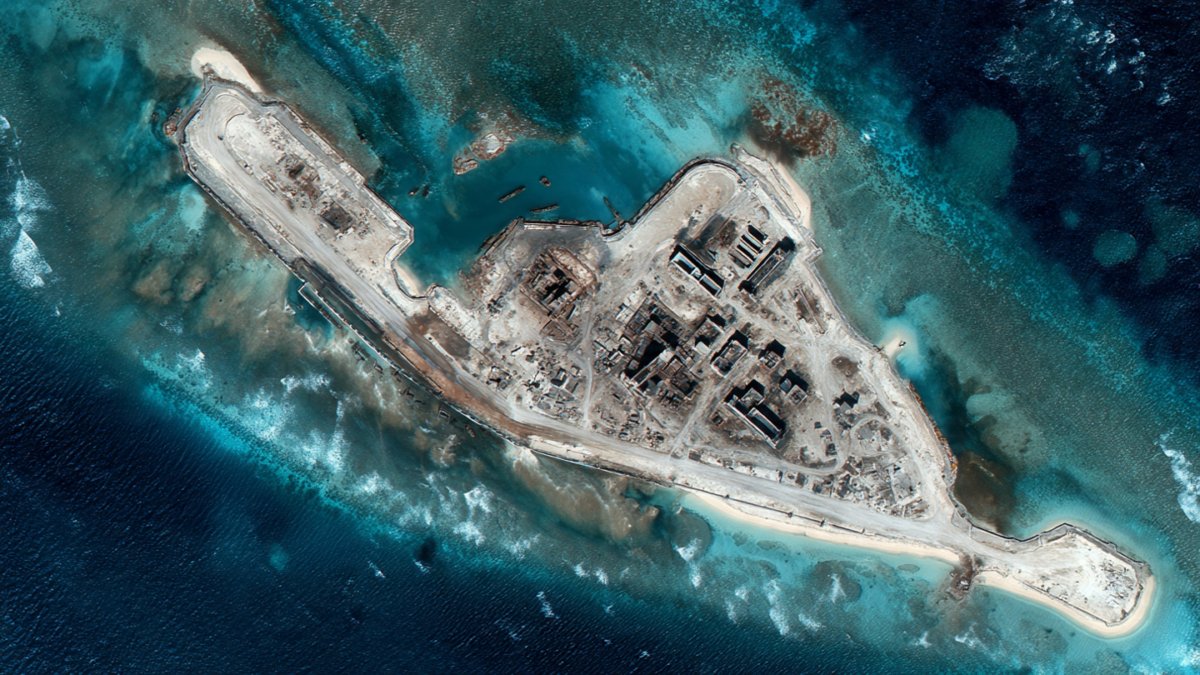
Over the past decade, China has transformed tiny, remote reefs in the South China Sea into massive, permanent military outposts, drawing global attention and controversy. By pouring millions of tons of concrete into shallow waters year after year, Beijing has reshaped the maritime landscape, creating strategic hubs capable of supporting military aircraft, naval vessels, and sophisticated radar systems. This systematic expansion has altered the balance of power in one of the world’s most contested regions, raising concerns among neighboring nations and international observers.
The South China Sea Dispute
The South China Sea is a critical body of water, rich in natural resources and strategic shipping lanes. About one-third of global maritime trade passes through it, including oil and gas shipments vital to East Asian economies. Several nations, including the Philippines, Vietnam, Malaysia, Brunei, and Taiwan, lay claim to overlapping portions of this vast maritime region.
China claims almost the entire South China Sea under its “nine-dash line,” a boundary that lacks legal recognition under international law. While disputes over territorial claims have existed for decades, China’s construction of artificial islands has dramatically escalated tensions. These artificial outposts give China the ability to enforce its claims more effectively and extend its military reach far beyond its mainland coast.
From Reefs to Islands: The Transformation Process
The process of transforming shallow reefs into fully functional islands is painstaking and resource-intensive. Many of the reefs in the South China Sea are tiny, submerged at high tide, and inhospitable to human life. China’s strategy has involved dredging sand and coral, pumping it onto the reefs, and layering it with massive amounts of concrete to create stable landmasses.

Over the years, this relentless effort has created islands capable of supporting airstrips, harbors, radar installations, missile systems, and military barracks. The scale of the operation is immense; satellite imagery shows the dramatic expansion of reefs that were once mere specks in the ocean into sprawling complexes covering several square kilometers.
Strategic Military Advantages
By converting these reefs into military outposts, China gains significant strategic advantages. First, airstrips on these islands allow for the deployment of fighter jets, reconnaissance aircraft, and early-warning systems. This enhances China’s ability to monitor naval movements across the South China Sea and respond rapidly to potential threats.
Second, the construction of ports and harbors enables China to station naval vessels, including patrol boats and larger ships, closer to disputed territories. This maritime presence serves both as a deterrent and as a means to assert control over contested waters.
Third, radar and missile installations extend China’s defensive and offensive reach. These systems can track aircraft, ships, and submarines, giving Beijing a significant tactical advantage in the event of a conflict. Together, these elements transform what were once isolated reefs into fortified military hubs capable of projecting power across the region.

Environmental and Legal Consequences
The creation of artificial islands comes at a significant environmental cost. The dredging of sand and coral destroys fragile ecosystems, killing coral reefs that have taken centuries to develop. These reefs support rich marine biodiversity, including fish, sea turtles, and migratory birds. The disruption caused by construction not only damages habitats but also affects fisheries that sustain millions of people in the region.
Legally, the United Nations Convention on the Law of the Sea (UNCLOS) restricts the creation of artificial islands in disputed waters. According to UNCLOS, artificial islands do not generate territorial seas or exclusive economic zones, meaning that China’s claims remain highly controversial. Despite international rulings, such as the 2016 Permanent Court of Arbitration decision rejecting China’s expansive claims, Beijing has continued to fortify its man-made islands.
Regional Tensions and Military Responses
China’s artificial islands have intensified regional tensions. Neighboring countries, particularly the Philippines and Vietnam, have protested against Beijing’s actions, citing threats to sovereignty and regional stability. Joint naval patrols and military exercises have become more frequent, reflecting growing concerns over China’s ability to dominate the South China Sea.
The United States and other Western powers have also increased their military presence in the region. Freedom of navigation operations (FONOPs) are regularly conducted to challenge China’s claims and demonstrate that international waters remain open to global shipping. These operations, though largely symbolic, are a reminder that the artificial islands serve not only as tools of territorial expansion but also as flashpoints for potential conflict.

The Human and Economic Dimension
While the artificial islands are primarily military in nature, they also have economic implications. Control over these reefs allows China to assert influence over fishing zones and potential underwater energy resources, including oil and natural gas reserves. This affects the livelihoods of fishermen from neighboring countries and heightens the stakes for regional economies dependent on maritime resources.
Moreover, the presence of military outposts alters trade routes and shipping patterns. Vessels navigating these waters must account for restricted areas and military activity, adding complexity and potential risk to global maritime commerce.
The Scale and Persistence of China’s Efforts
China’s strategy is not a short-term initiative. The continuous dumping of concrete, sand, and building materials over years demonstrates a long-term commitment to solidifying control over contested areas. Satellite imagery and independent reports reveal the scale of the transformation: reefs that were once underwater or barely visible at high tide are now islands with airstrips capable of hosting military jets and radar installations.
The persistence of these efforts signals that China intends to maintain a permanent military presence in the South China Sea, reshaping the geopolitical landscape in a way that may endure for decades.

International Reactions and Diplomatic Challenges
The international community has responded with concern and condemnation, but limited enforcement mechanisms exist. Diplomatic protests, economic sanctions, and legal challenges have not halted China’s construction, highlighting the limits of international law in curbing the ambitions of a major global power.
ASEAN countries have struggled to present a unified response, as economic ties with China complicate political positions. Meanwhile, global powers continue to balance strategic deterrence with diplomacy, emphasizing dialogue while preparing for potential confrontations.
Future Implications
The creation of permanent military outposts on disputed reefs has long-term implications for regional security. These islands serve as forward operating bases, giving China the ability to project power and influence far beyond its borders. The militarization of the South China Sea could lead to an arms race, with neighboring countries enhancing their own naval and air capabilities to counterbalance China’s presence.
Additionally, the environmental destruction may have lasting consequences for marine ecosystems, affecting biodiversity and regional food security. The combination of military, economic, and ecological impacts underscores the complexity of the South China Sea dispute and the high stakes involved.

Conclusion
By pouring millions of tons of concrete into shallow waters year after year, China has successfully turned disputed reefs into permanent military outposts, fundamentally altering the strategic landscape of the South China Sea. These man-made islands enable Beijing to project military power, control trade routes, and assert territorial claims despite international opposition.
The transformation of tiny, inhospitable reefs into fully functional islands highlights both the ambition and persistence of China’s maritime strategy. While these outposts provide clear strategic advantages, they also escalate regional tensions, threaten fragile ecosystems, and challenge international legal norms.
As the world watches, the South China Sea serves as a reminder that geopolitical influence is increasingly tied to both technological capability and environmental engineering. The question for the international community is whether diplomatic, legal, and strategic measures can keep pace with these unprecedented changes—or whether the artificial islands will become enduring symbols of China’s dominance in one of the most vital maritime regions on Earth.

Leave A Comment