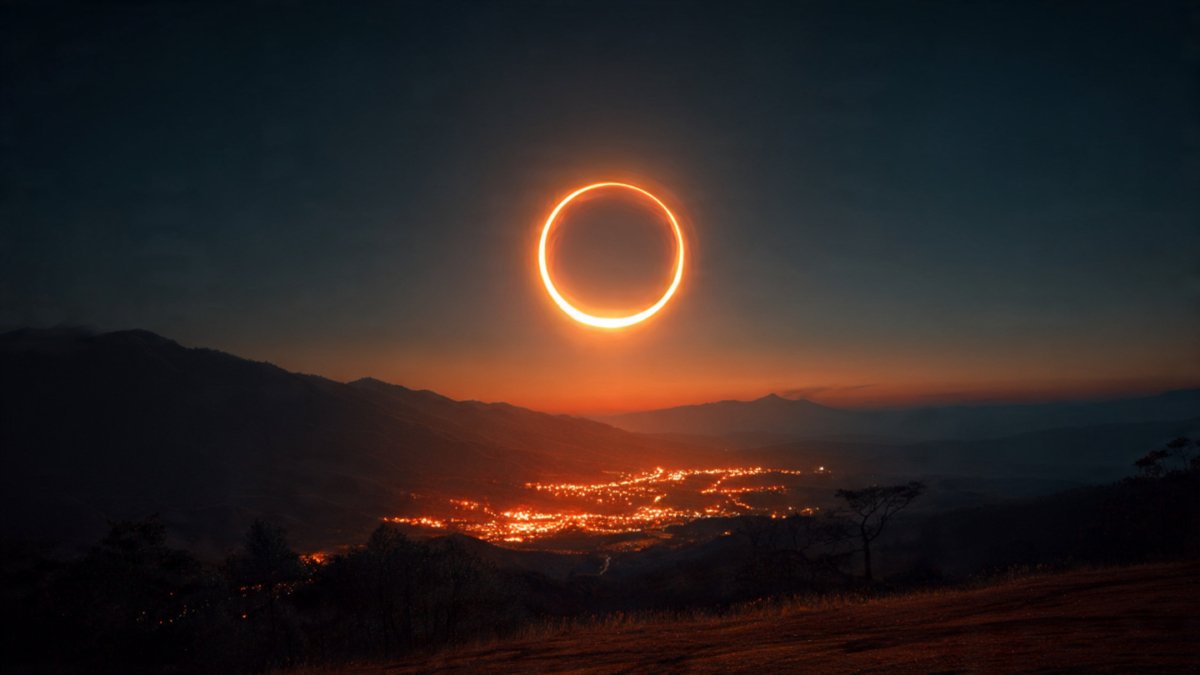
Few natural events inspire as much wonder as a total solar eclipse. For a brief moment, the blazing Sun disappears, daylight fades into eerie twilight, stars emerge, and temperatures drop. Birds fall silent, winds shift, and people around the world stop what they are doing to look up at the sky. Now, astronomers have confirmed that one of the most extraordinary eclipses of the century is already scheduled—and its unusually long duration is leaving scientists and skywatchers amazed.
This rare celestial event will transform day into night for several minutes, offering a once-in-a-lifetime opportunity to witness the universe in motion. Unlike typical eclipses that last only a short time, this one will stretch far beyond the average, making it one of the most remarkable astronomical phenomena of our era.
What Is a Solar Eclipse?
A solar eclipse occurs when the Moon passes directly between the Earth and the Sun, blocking sunlight either partially or completely. This alignment happens only during a new moon, when the Moon’s shadow falls on Earth.
There are three main types of solar eclipses:
- Partial eclipse, where only part of the Sun is covered
- Annular eclipse, where the Moon appears smaller and leaves a bright ring
- Total eclipse, where the Sun is completely hidden
During a total eclipse, the Moon perfectly covers the Sun’s disk, revealing the Sun’s outer atmosphere, known as the corona. This is the most dramatic and scientifically valuable type of eclipse.
The upcoming event belongs to this rare category and stands out because of how long total darkness will last.
Why This Eclipse Is So Special
Most total solar eclipses last between one and three minutes at any given location. Only a few extend beyond four minutes, and eclipses longer than six minutes are extremely rare.
The upcoming eclipse is expected to last over seven minutes at its maximum point, placing it among the longest of the entire century. Scientists describe this duration as exceptional, because it approaches the theoretical maximum length possible for a total solar eclipse.
Several precise cosmic factors must align perfectly for such an event to occur, making it both rare and scientifically valuable.

The Science Behind the Extraordinary Duration
The length of a solar eclipse depends on the exact positions and distances of the Earth, Moon, and Sun. For a long-lasting eclipse to occur, multiple conditions must be met simultaneously.
1. The Moon Must Be Close to Earth
The Moon’s orbit around Earth is slightly elliptical, meaning its distance varies. When the Moon is at its closest point, called perigee, it appears larger in the sky.
A larger Moon can block the Sun more effectively and for a longer time.
2. The Earth Must Be Far from the Sun
Earth’s orbit is also elliptical. When Earth is at its farthest point from the Sun, called aphelion, the Sun appears slightly smaller.
A smaller-looking Sun is easier for the Moon to cover completely.
3. Perfect Alignment
The centers of the Sun and Moon must align almost perfectly. Even a small misalignment can shorten the eclipse.
This precise positioning allows the Moon’s shadow to move more slowly across Earth’s surface, extending the duration of totality.
4. Shadow Path Near the Equator
When the eclipse path passes close to Earth’s equator, the planet’s rotation speed is highest. This helps keep the Moon’s shadow over one region for a longer time.
All these conditions will come together during this upcoming event, creating an eclipse of extraordinary length.

When and Where It Will Happen
The longest eclipse of the century is scheduled for the mid-21st century and will travel across parts of Europe, North Africa, the Middle East, and Asia. Several countries will experience full totality, while many others will witness partial coverage.
People located directly in the “path of totality” will enjoy the full experience, including complete darkness, visible stars, and the solar corona.
Those outside this path will still see a partial eclipse, but the dramatic transformation of day into night will only occur within a narrow corridor.
Astronomers are already mapping observation sites, weather patterns, and travel routes, as millions of people are expected to gather along the eclipse path.
How Day Turns into Night
As the Moon slowly moves across the Sun, the light begins to fade gradually. At first, the change is subtle. Shadows sharpen, colors look strange, and temperatures start to drop.
Minutes before totality, the environment becomes surreal.
- The sky darkens rapidly
- The horizon glows orange and red
- Birds and insects behave as if evening has arrived
- Winds may shift suddenly
Then, in a matter of seconds, the Sun disappears completely.
For several minutes, daytime becomes night. Stars and planets become visible. The Sun’s corona shines like a silver crown around the dark Moon. This moment is often described as emotional, overwhelming, and unforgettable.
When totality ends, sunlight returns just as suddenly, restoring normal daylight.

Why Scientists Are So Excited
Long eclipses are not just visually impressive. They are also extremely valuable for scientific research.
Studying the Solar Corona
The Sun’s corona is usually hidden by bright sunlight. During totality, it becomes visible, allowing scientists to study its structure, temperature, and magnetic fields.
Understanding the corona helps researchers learn more about solar storms and space weather that can affect satellites and power grids.
Testing Physical Theories
Eclipses have historically played a role in testing major scientific ideas. In 1919, a solar eclipse helped confirm Einstein’s theory of relativity.
Modern eclipses continue to provide opportunities to test advanced physics models.
Observing Atmospheric Changes
Scientists study how Earth’s atmosphere reacts to sudden darkness. Temperature, wind, and electrical changes are carefully measured during eclipses.
These observations improve climate and weather models.
Advancing Space Technology
Many space agencies use eclipses to test instruments, satellites, and imaging systems under unique conditions.
The long duration of this eclipse gives researchers more time than usual to collect high-quality data.

How Rare Are Such Long Eclipses?
Extremely long eclipses occur only a few times per century. Even then, they are usually visible from remote oceans or uninhabited regions.
An eclipse of this length passing over populated areas is especially rare. For many people alive today, this will be the longest and most dramatic eclipse they will ever witness.
Some regions along the path may not experience another similar event for hundreds of years.
Preparing to Watch the Eclipse
For those planning to witness this historic moment, preparation is essential.
Eye Safety
Never look directly at the Sun without proper protection. Use certified solar viewing glasses or special filters. Ordinary sunglasses are not safe.
Only during totality is it safe to look with the naked eye.
Choosing the Right Location
Being inside the path of totality is crucial. Even a few kilometers outside it can reduce the experience significantly.
Many people will travel long distances to reach optimal viewing spots.
Weather Planning
Clear skies are necessary for a good view. Observers often monitor weather forecasts and prepare backup locations.

Equipment
Binoculars, telescopes with filters, cameras, and tripods can enhance the experience. However, many experts recommend spending at least part of totality simply watching with your eyes.
Cultural and Emotional Impact
Throughout history, eclipses have inspired fear, myths, and legends. Ancient civilizations saw them as messages from gods or signs of major change.
Today, science explains the phenomenon, but the emotional impact remains powerful. Many people describe eclipses as life-changing experiences that create a deep sense of connection with the universe.
Families, communities, and even strangers often gather together, sharing a moment of collective wonder.
Final Thoughts
The longest solar eclipse of the century promises to be one of the most extraordinary natural events of modern times. For several breathtaking minutes, daylight will vanish, the sky will darken, and the hidden beauty of the Sun will be revealed.
This rare alignment of cosmic forces will not only astonish scientists but also inspire millions around the world. It reminds us that despite technological advances and busy lives, we remain part of a vast, dynamic universe.
When day turns into night and the Sun’s crown shines in the darkness, it offers a powerful reminder of nature’s precision, beauty, and mystery. For those fortunate enough to witness it, this eclipse will be remembered forever as a moment when time seemed to stand still and the universe put on its greatest show.

Leave A Comment